
The hard part about removing invasives is getting started! Anyone can do it. You just need to figure out which plants you are dealing with and be a little careful with a few species that need special control methods.
The first step is to identify the species precisely and check the management recommendations. For most species in your yard, you can just start yanking away. For others, timing and the exact control method may be important. The species in bold on the list below are examples of those. In natural areas, you first must have the landowner’s permission, of course, and you’ll need to be particularly careful to protect the native vines and other native species.
For short summaries of various common species, see this spreadsheet. In almost every case, repeated treatment will be needed over several years.
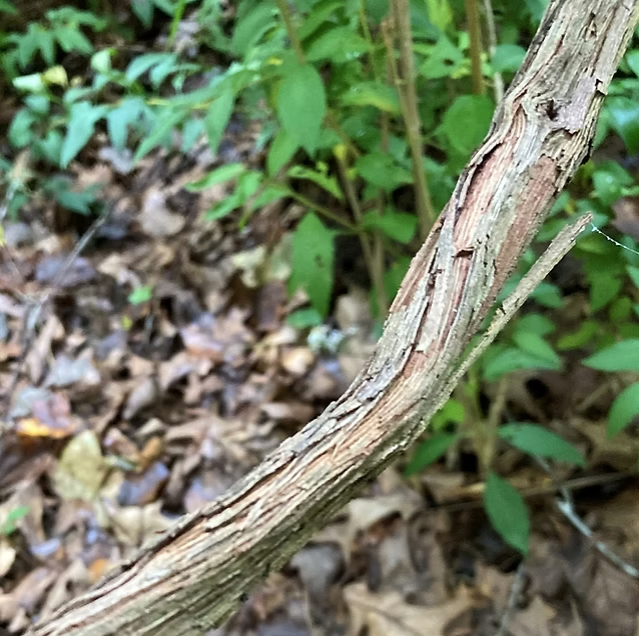
Be careful with the native vines!
Common management techniques
Excellent descriptions of recommended management techniquest can be found on the Blue Ridge PRISM website. General guidelines apply to most species, but there are important exceptions, some of which are noted in the list below. Before working on any invasive, it is essential to read about the correct method for that species! Using the wrong method can make the situation much worse.
Wear gloves! Protect yourself from thorns and allergic reactions.
Invasive vines on trees
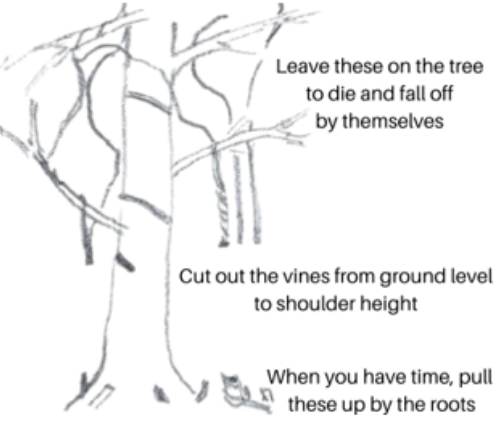
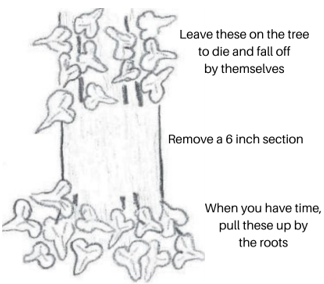
Cut near the ground and again at shoulder height to create a gap. Kill the roots either by removing them or by cut-stump treatment (dabbing herbicide on the stump cut within six inches of the ground). If you are cutting and plan to return later with herbicide, cut at knee height so you can re-cut later.
Timing: Timing depends on the plant and the technique. Look it up. When possible, it’s good to treat plants before they go to seed.
Cutting alone: If you are able to cut or mow several times a year, that may be enough to eventually kill some plants by exhausting the energy resources. Important note: Simply cutting some plants may stimulate sprouting from the roots, greatly worsening the problem.
Herbicides: Herbicide use is very complicated. If you choose to use them, you must learn the correct techniques, timing, safety precautions, and legal requirements. See the pages on herbicide tips and herbicide safety.
Debris management: Some plant parts can be left on the ground. Others should be removed if possible, particularly seeds and plants with chemical properties that prevent the growth of other plants. Uprooted roots may reroot, so they should either be hung somewhere to dessicate or removed altogether.
Common or high priority plants in Fairfax/Falls Church
In bold are species of highest priority. This spreadsheet summarizes treatments for most of these plants and has links to more details.
Vines
- Porcelain-berry Ampelopsis glandulosa
- English Ivy Hedera helix
- Wintercreeper Euonymus fortunei
- Japanese and Chinese Wisteria Wisteria floribunda and Wisteria sinensis
- Kudzu Pueraria montana var. Lobata Five-leaved Akebia Akebia quinata
- Mile-a-Minute Persicaria perfoliata
- Japanese Honeysuckle Lonicera japonica
- Oriental Bittersweet Celastrus orbiculatus
- Five-leaf Akebia Akebia quinata
Trees
- Callery Pear Pyrus calleryana
- Tree-of-Heaven Ailanthus altissima
- Special precautions: Except for trees small enough to uproot, you have to kill the tree before removing it, and that must be done at a certain time of year. Otherwise, it will send up a hundred new trees from the roots.
- White Mulberry Morus alba
Shrubs
- Autumn Olive Elaeagnus umbellata
- Special precautions: Sometimes, though not always, simple cutting will cause it to send up a hundred new plants from the roots. Also, Autumn olive plant material contains chemicals that prevent the growth of other plants. Therefore, the debris needs to be removed.
- Bush Honeysuckle Lonicera maackii and Lonicera morrowii
- Multiflora Rose Rosa multiflora
- Japanese Barberry Berberis thunbergii
- Burning Bush Euonymus alatus
- Leatherleaf Mahonia Mahonia bealei
- Linden Viburnum Viburnum dilatatum
- Privet species
- Wineberry Rubus phoenicolasius
Grasses
- Wavyleaf Basketgrass Oplismenus undulatifolius
- Special precautions: The seeds of this plant are incredibly sticky. To avoid spreading it, you need to either spray it or (preferably) remove it before it goes to seed (or both). If it is mixed with other plants, it is possible to get a grass-specific herbicide.
- Miscanthus grass Miscanthus sinensis
- Japanese Stiltgrass Microstegium vimineum
- Running Bamboo Phyllostachys aurea and others
- Fountain Grass Cenchrus purpurascens
Forbs
- Lesser Celandine Ficaria verna
- Japanese Knotweed Reynoutria japonica var. Japonica
- Poison Hemlock Conium maculatum
- Special precautions: Exposing your skin to this plant can harm you. Careful precautions are needed.
- Incised Fumewort Corydalis incisa