Mini-grant Boosts Continued Removal Effort in Fairfax
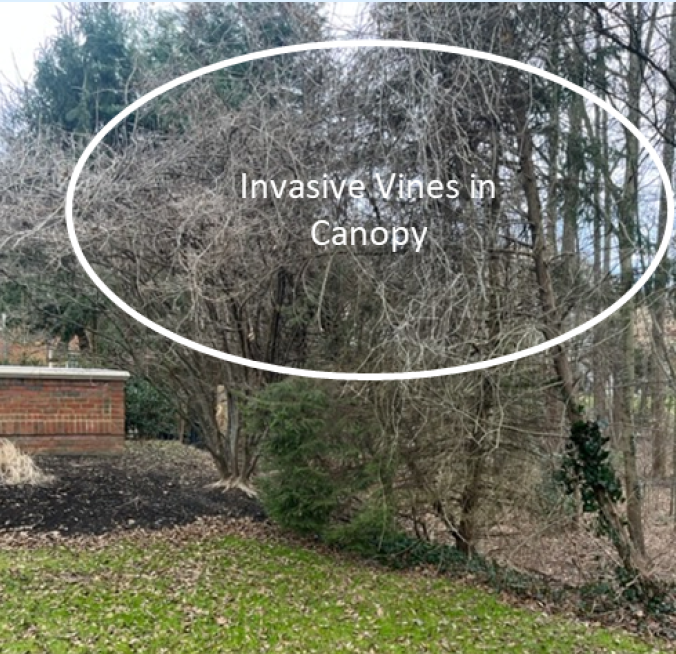
Driven by a 2023 plea from the City to communities and organizations across Fairfax, Pickett's Reserve HOA embarked on a program to control and eradicate invasive species around their community. They initiated the program through a contractor, Residential Reforestation (RR), in 2024. Results were impressive but it became clear that they needed a sustaining effort to retain and expand on the program's success. They continued to invest in contracts with RR, and reached out to PRISM in 2026 for assistance through a mini-grant application.
Main Species of Concern: Oriental bittersweet, wisteria, porcelain berry, English ivy, bush honeysuckle, autumn olive, invasive pear tree.
Previous Efforts: The invasive species project at Pickett’s Reserve has been managed over the past two years and continues to need attention. Pickett’s Reserve initiated the program in 2024 through a $5,600 contract with Residential Reforestation (RR) which included spring and fall herbicide treatments. In 2025 they signed a $3,600 sustaining contract with RR which resulted in additional improvement.
Management Strategy: All work was performed by the hired contractors, Residential Reforestation (RR), on common areas around the community. No homeowners were involved in control efforts.
- Vines: Wisteria was treated with foliar application and other vines (bittersweet, English ivy, Japanese honeysuckle porcelain berry) were cut and treated with herbicide. Porcelain berry and wisteria will require additional treatments to maintain control. The English ivy acting as ground cover was treated with foliar application.
- Woody Species: Bush honeysuckle and autumn olive were controlled through foliar application and will need continued monitoring to maintain relative minimal incursion. Invasive pear trees along the roadside were controlled with hack and squirt.
- Herbicide mixtures included a nonionic surfactant as well as an adjuvant and blue dye. For many species glypho54 (81927-8) or equivalent was applied as a 3% solution. Woody species within the forested areas were treated with Crossbow (62719-260-829) or equivalent as a 1.5-2% solution. Hack and treat method required triclopyr4 (81927-11) or equivalent mixed with a carrier oil at a rate of 33% mix ratio and include dye and penetrant.
Project Outcomes
Trees saved: About 250 trees were saved.
Scope of the grant: Approximately 42,000 square feet (1.2 Acres) of land was treated with the $3,600.00 grant.
Financial Summary
Pickett’s Reserve requested a reimbursement of $3,600.00, which covered the project entirely. They were required to meet a 50% contribution match of $1,800.00 which they met by directly funding additional work with Residential Reforestation.
Community Education
- Pickett's Reserve has a monthly HOA meeting where they have described the invasive species work and their PRISM grant acceptance.
- Pickett’s Reserve contains 89 households and approximately 300 total residents. To reach the community, Pickett’s Reserve included information in the HOA newsletters sent to all residents. At least 5 monthly newsletters included a section describing the invasive vine problem and the means the HOA is taking to treat and reduce their impact. They also listed information about the grant and their efforts to successfully fulfill the grant requirements.
Next Steps
Pickett’s Reserve plans to continue monitoring and managing species of concern over the next three years or more. The site covered by this project will require continued herbicide treatment for aggressive vines such as wisteria and porcelain berry.