Why This Matters?
If we are to save the trees in our natural spaces, the whole community must take direct responsibility. Public agencies (town, county, state, federal) only have budget to manage a small fraction of land. Volunteerism helps—but significant funding is needed for professional invasive control services where work is complex or large-scale.
Bottom line: Volunteer power + targeted funding = real, sustained impact.
Two Ways To Help
Rights of Way (VDOT)
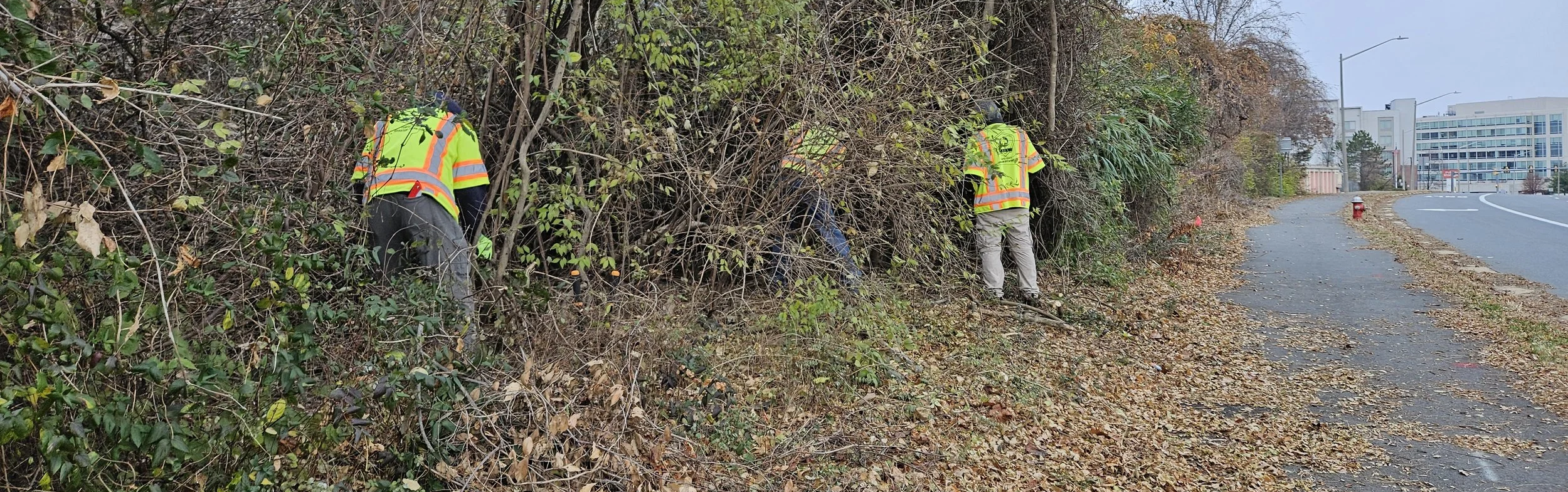
The Virginia Department of Transportation currently has a budget of zero to spend on invasive plant control, but they do have a process for issuing permits to people who do the work. You can volunteer to do simple cutting, but current law does not allow volunteers to use herbicides on state-owned land.
Can you or your neighborhood adopt the right of way and pay your landscaping company (or another contract) to do that work?
If you have permission from an adjacent landowner, no VDOT permit is required.
Parks
The parks welcome trained and authorized volunteers to help cut or pull up invasive plants. In the case of Fairfax County Park Authority and the National Park Service, you can sign up for events led by others or be trained on how to work independently. (It is illegal to disturb the vegetation without permission.)
HOWEVER: Some of the more difficult work requires professional control methods. The parks have funding to control invasives on less than 10% of their properties and would welcome your help. Can you, your neighborhood, or your corporation adopt a park (or part of a park) to pay for needed professional services for at least three years of treatment? Expect a cost of approximately $2500-$3000 per acre of infestation in Year One, then half that each of the following 2-4 years. After that, volunteers should be able to manage most small recurrences, or you could continue to fund professional work. Donations for this purpose would go directly to the parks, not to Fairfax Tree Rescuers PRISM.
The same procedure that applies to corporations also applies to other individuals or groups.
Let’s Move Our Parks Into the Blue!
Volunteers have been surveying the natural areas of the parks and assigning them grades based on what percentage of the trees are threatened by invasive vines, how badly invasive plants are preventing access to our parks, and how much of the park is being overrun. (If you have experience with invasive plant identification and would like to help with the surveys, see this page.)
Invasive Vines Threatening Trees
Approximate percentage of trees at serious risk from invasive vines (either way up in the canopy, or girdling the trunk). Include trees that are more than a few feet high.
Blue - Great! - Few or no invasive vines on the trees.
Yellow - Could be better - Vines are on the trees but not yet girdling or way up in the canopy, or on only a very small percentage.
Orange - Getting bad - Vines seriously threaten up to a quarter of the trees
Red - Terrible - More than a quarter of the trees are under serious threat.
Access to Parks (as affected by invasive plant infestations)
Evaluate the accessibility of the "natural" parts of parks - exclude developed areas such as ballparks, buildings, lawns, etc.
Blue - Excellent (Accessible) - Invasive species are present at very low levels and do not impede access. Trails and use areas are fully open and easy to navigate.
Yellow - Good (Slightly Impeded) - Invasive species partially restrict movement. Trails or access points may be narrowed or lightly obstructed, causing minor inconvenience but remaining passable. There may be a few isolated areas that are inaccessible, but the majority of the area is passable.
Orange - Getting bad (Moderately Impeded) - Invasive species significantly hinder access. Movement beyond trails or developed areas requires detours, stepping over or pushing through vegetation, or may discourage some visitors. Portions of the area are difficult to reach.
Red - Bad (Inaccessible) - Dense invasive cover blocks or closes access entirely. The area is effectively impenetrable and cannot be used without major clearing.
Overall Severity of Invasive Plants
Evaluate the degree of invasion of the "natural" parts of parks - exclude developed areas such as ballparks, buildings, lawns, etc.
Blue - Invasive nonnative plant species apparently absent. Invasive plants are not noticeable even when looking carefully. Native plants dominate every visible layer.
Also Blue - Very Good - Invasive nonnative plant species present but sporadic (1–3% cover). Occasional invasive plants or small clumps occur here and there. They’re widely scattered, not forming patches, and most people would overlook them on a casual walk.
Yellow - Good - Invasive nonnative plant species somewhat common (4–20% cover). Invasive plants are present in repeated patches. They’re noticeable but not overwhelming—for example, scattered clusters along a trail or in openings, but still a minority of the vegetation
Orange - Getting bad- Invasive nonnative plant species common (21-50% cover). Invasive plants are easy to find and present in many parts of the site. They may form frequent patches or partial carpets, and natives are clearly being displaced in some areas.
Red - Bad - Invasive nonnative plant species abundant (>50% cover). Invasive plants dominate large areas, sometimes forming continuous or nearly continuous cover. You may see monoculture-like patches, with natives noticeably reduced or absent.