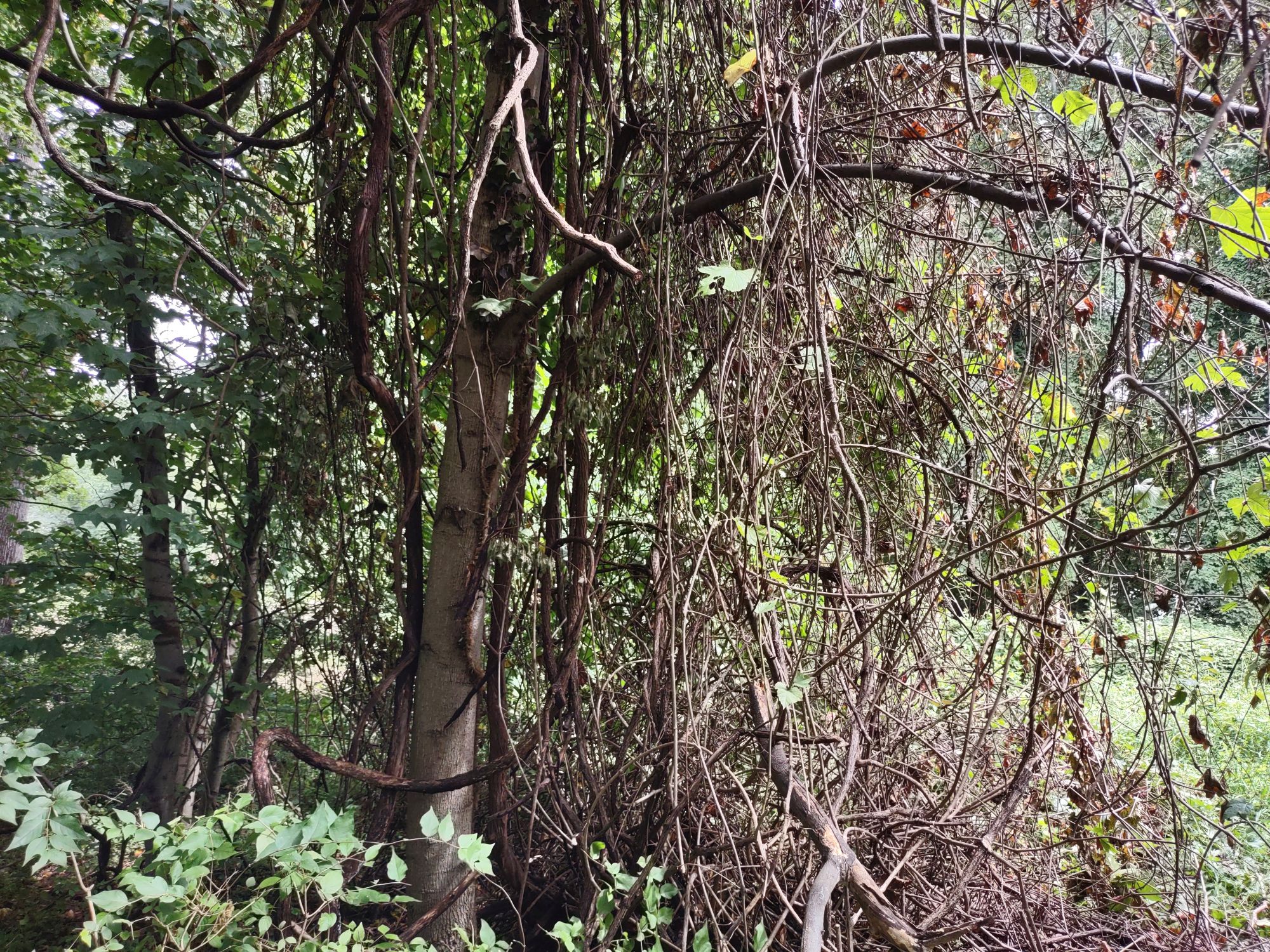
 Olam Tikvah site before restoration
Mini-grant Boosts the Restoration of Native Vegetation in Fairfax
An area on the Olam Tikvah Congregation’s property containing severely damaged trees due to invasive vines was not only an eyesore, but also had a major impact on the natural environment that borders the property. The degraded area was destroying wildlife habitat and contributing to runoff erosion into the nearby stream. The Synagogue took action to remove invasive plants and plant native ones in their place to restore the natural riparian area.
Main Species of Concern: Porcelainberry was the dominant species, but multiflora rose, Japanese honeysuckle, English ivy, and autumn olive were also present. Most invasive plants were concentrated around the edges of the site.
Prior Work: Includes about 40 hours clearing and cutting porcelainberry vines that had been strangling trees along the edge of Olam Tikvah’s property clearing. They also planted native trees and shrubs (redbud, viburnum, sumac, and spicebush) and perennials (mountain mint, golden alexander and others) along this edge where vegetation had been cleared.
Permission from the Community: The restoration project was proposed by the Olam Tikvah Congregation’s Green Team, which advocates for environmentally friendly solutions for the Synagogue. The team successfully advocated the project to Olam Tikvah leaders.
With the site being in a riparian zone, Olam Tikvah submitted an application for a Riparian Protection Area waiver through Fairfax County’s Accela Citizen Access website. They also submitted a VA118.com request to ensure they weren’t digging near any utility lines.
Management Strategy
Olam Tikvah created a 3-year plan with the help of their contractor, Invasive Plant Control Inc. Volunteers coordinated with the contractor to produce the best treatment effect.
- Volunteer Work: Volunteers cut and removed invasive vines and Japanese stiltgrass that were easily reached from the edge of the property.
- Work by the Contractor: Work done before April 30th by Invasive Plant Control was grant-funded and cost a total of $1,387.50. The contractor cut honeysuckle and multiflora rose then treated the freshly cut stumps with herbicide. They also used foliar treatment on visible honeysuckle and English Ivy leaves.
- Additional Work: Work continued after the grant deadline as part of the 3-year plan and was self-funded by Olam Tikvah. This includes an additional foliar treatment in the summer for later leafing species and follow-up treatments during the growing season of year 2 and 3. The synagogue also planted native plants in the areas that were cleared of invasives and continued to host volunteer events.
The contractor used a 50% Aquamaster to treat stumps and a foliar treatment of 2% Aquamaster and 2% Garlon 3A. The cut debris was left in the wooded area to naturally decompose and return nutrients to the soil.
Project Outcomes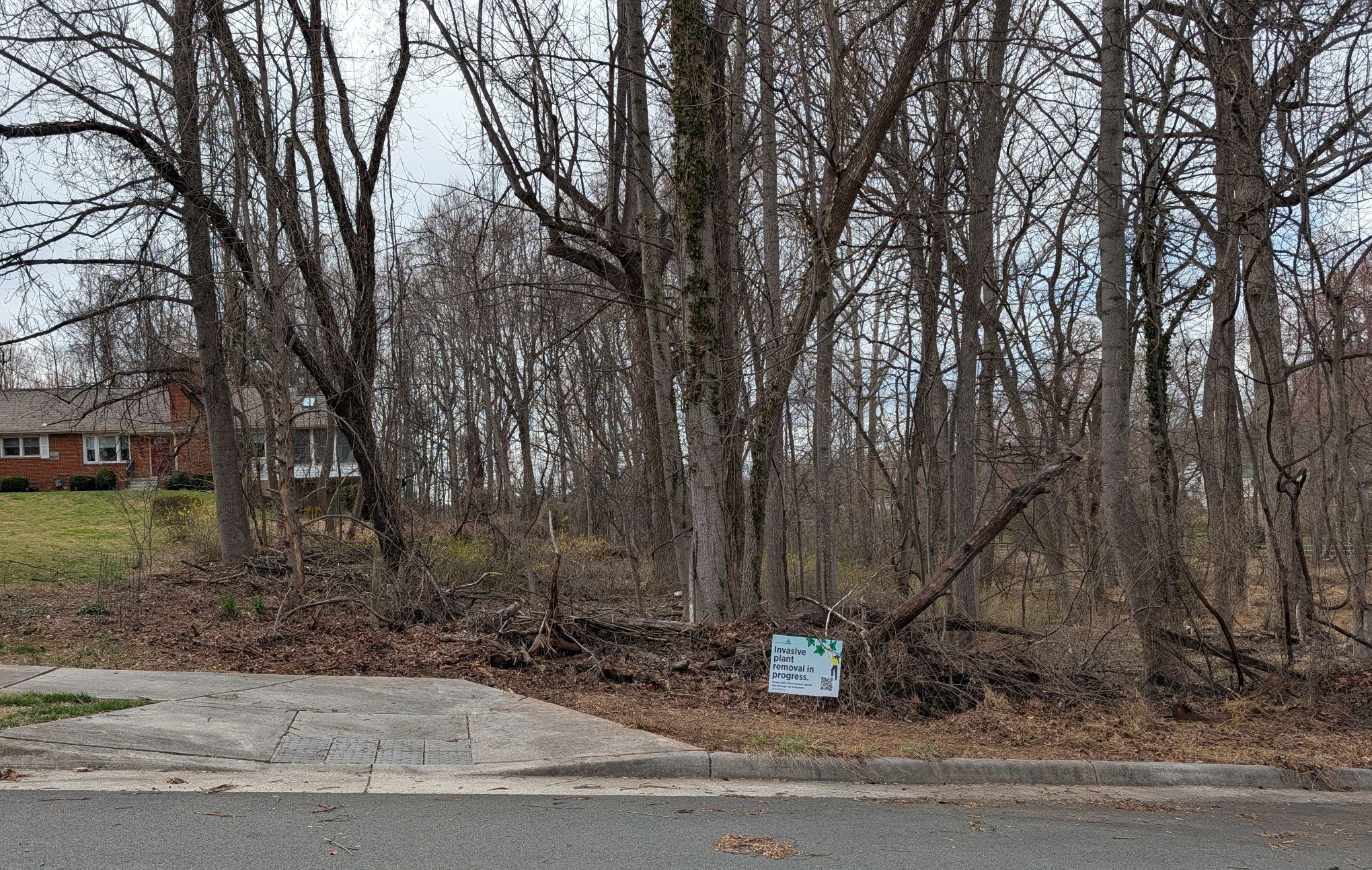 Olam Tikvah site after restoration
Volunteer Hours: At least 7 volunteers worked a total of 20.75 hours, exceeding the required 50% match of 20 hours (at $34.79/hr).
Trees Saved: About 100 trees were saved, including 50 mature trees and 50 younger trees.
Scope of the Grant: Approximately 2500 sq ft of land was treated. As a riparian area, the site is important for wildlife habitat, water quality of the nearby stream, and erosion control.
Financial Summary
Olam Tikvah requested a reimbursement of $1,387.50 and were required to meet a 50% contribution match of $693.75. They completed 20.75 volunteer labor hours to meet contributions, equaling a $721.89 match ($34.79/hr) and exceeding the minimum required match ($693.75).
Community Education
- The Olam Tikvah Green Team worked with Olam Tikvah school groups to educate kids and parents about the project, and highlighted the project to the entire congregation during services and other events.
- At some Olam Tikvah holiday events, the Green Team had booths set up to explain the project to congregants and handed out brochures to approximately 50 people.
Next Steps
- As part of their 3-year plan, Olam Tikvah plans to continue treating and removing invasive plants on their property. They also aim to plant more native shrubs, trees, and ground cover wherever there is bare ground that has been cleared of invasives.
- Olam Tikvah will continue to monitor the progress of treatments and for the early detection of new invasives. They anticipate a routine need for volunteer work and occasional professional work.