
What Homeowners Need to Know
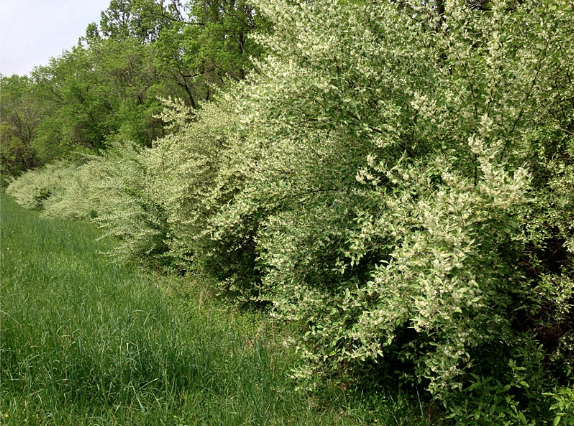
Many of our yards, fields, woods, and roadsides in Fairfax have become infested with Autumn olive (Elaeagnus umbellata). An alarming example is Hemlock Overlook, that park that is so popular with walkers and runners and with generations of children on school trips but where Autumn Olive is steadily encroaching from the edges. It was introduced to North America in the 1830s to revegetate strip mines and create wildlife habitat, because it thrives in poor soil and produces abundant fruit. But today it is one of the most disruptive invasive shrubs in the eastern United States, forming dense stands that displace native plants and alter soil chemistry.
Though technically a shrub because it is multi-stemmed, it grows as tall as small trees and spreads out widely, shading out everything beneath. It changes the soil chemistry in ways that favor its own growth and inhibit the growth of native plants. It leafs out early in spring with bright silvery foliage and produces heavy fruit crops that wildlife spread widely from our yards onto our neighbors’ properties and into the parks and back again.. It will take a joint effort by all property owners for us to control this major pest.
Why Autumn Olive Is Such a Problem
- Forms dense stands in sunny fields, roadsides, and forest edges
- Outcompetes native plants and reduces species diversity
- Alters soil chemistry through nitrogen‑fixing roots
- Pollutes streams and rivers by increasing nitrate levels
- Produces up to 30 pounds of fruit and 65,000 seeds per plant each fall
How to Identify It (see detailed photos of Fairfax examples on iNaturalist.)
- Bright silver new leaves in early spring
- Mature leaves olive‑green with silvery undersides
- Leaves alternate on stems
- Thorns often present on twigs and branches
- Creamy, fragrant four‑petaled flowers in early spring
- Red, single‑seeded fruits dotted with tiny silvery speckles
How It Spreads
- Heavy fruit production is eaten and dispersed by wildlife
- Fruits linger into winter; uneaten fruits drop and self‑seed
- Deep taproot allows drought tolerance and rapid establishment
- Cutting without herbicide increases stem density
For More Information
Please visit Blue Ridge PRISM for the full Autumn Olive Fact Sheet