
An EDRR (Early Detection and Rapid Response) plant is a species that has recently arrived in a specific region—whether that is Northern Virginia, Fairfax County, your local park, or your own property. The defining characteristic of an EDRR plant is that it does not yet have a widespread foothold in the natural area.
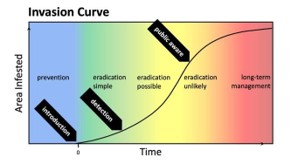 Invasive species curve. Courtesy of Sara Tangren.To understand why these plants deserve our immediate attention, it helps to look at the invasive species curve. For well-established invasive plants, eradication is extraordinarily difficult, labor-intensive, and expensive—especially when dealing with ornamental plants that require extensive community education and legislative effort. EDRR targets species at the very beginning of the curve, where swift detection and removal can stop an infestation before it becomes unmanageable.
How You Can Help
Effective EDRR work relies on proactive surveying and close collaboration between private property owners and public land managers. That is where community involvement comes in:
- Monitor Your Yard: Keep an eye on the plants in your own yard and make sure no EDRR species—or other non-native invasive plants—take root.
- Log Observations on iNaturalist: If you spot an unfamiliar plant while hiking or exploring, upload your observation to iNaturalist. Many local ecologists and natural resource managers actively use iNaturalist to track new plant observations and emerging threats in their parks.
Key Resources for Identification and Learning
- Fairfax County Park Authority’s EDRR Page: Provides a targeted list of regional EDRR problem plants, along with essential guidance on identification, spread prevention, and treatment.
- Blue Ridge PRISM EDRR ID Sheets: An invaluable, photo-rich reference for accurate plant identification.