
What Homeowners Need to Know
Nonnative varieties of bush honeysuckles (Lonicera species) are rapidly spreading across Fairfax County’s roadsides, forest edges, parks, and neighborhood woodlots. Despite their attractive and sweet-smelling flowers, these upright shrubs grow 6–16 feet tall and form dense thickets that block sunlight, deplete soil moisture, and interfere with the life cycles of native plants. The flowers look very much like those of their cousin, the tree-killing Japanese Honeysuckle vine. Their red‑to‑orange berries are eaten by birds, which then spread the seeds throughout the landscape.
A recent project in South Run Regency, near Burke Lake, shows how serious the problem can become — and how effective community action can be. Volunteers and a grant‑funded contractor cleared massive thickets of Amur honeysuckle and other invasive shrubs, saving dozens of mature trees and reopening forest paths that had been inaccessible for years. Their work demonstrates how quickly bush honeysuckle can overwhelm a neighborhood forest — and how neighbors working together can reclaim it.
Why Bush Honeysuckle Is Such a Problem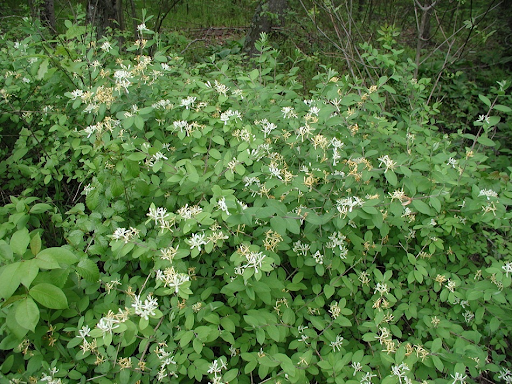
- Forms dense shrub layers that block sunlight
- Depletes soil moisture and nutrients
- May release chemicals that inhibit native plant growth
- Produces abundant berries that birds spread widely
- Invades roadsides, forest edges, pastures, and disturbed woodlots
- Expands rapidly across northern and central Virginia
How to Identify It
(See detailed photos of Fairfax examples of Amur Honeysuckle, the most common species, on iNaturalist.)
- Upright deciduous shrub, 6–16 feet tall
- Opposite, oval leaves 1–2.5 inches long
- Fragrant tubular flowers in pairs (May–June; February–April for fragrant honeysuckle)
- Flowers creamy‑white, yellowing with age; some species pink or crimson
- Red to orange many‑seeded berries
- Often confused with native fly honeysuckle — but that species is rare and found only at high elevations
How It Spreads
- Birds eat the berries and disperse seeds widely
- Shrubs thrive in disturbed soils, forest edges, pastures, and abandoned fields
- Some species invade wetlands, bogs, and lakeshores
- Dense thickets expand quickly once established
For More Information
Please visit the Ohio Tech website for control methods.