
What Homeowners Need to Know
Many of our woods, trails, and neighborhood edges in Fairfax are being overtaken by Asiatic bittersweet (Celastrus orbiculatus), a vine that climbs rapidly into tree canopies and spreads aggressively across the forest floor. Introduced from Asia in the 1860s as an ornamental plant, it has become one of the most destructive invasive vines in the eastern United States.
A striking local example comes from Clifton, where volunteers with the Clifton Tree Rescuers recently freed a young Eastern Red Cedar and other trees that had been nearly smothered by bittersweet and honeysuckle. Their work shows how quickly this vine can overwhelm trees — and how community action can make a real difference.
Asiatic bittersweet grows fast, twining tightly around trunks and branches, girdling trees, toppling them under the vine’s weight, and shading out native shrubs and wildflowers. Birds and people spread the bright red-and-gold fruits widely, making neighborhood‑to‑neighborhood reinvasion common.
Why Asiatic Bittersweet Is Such a Problem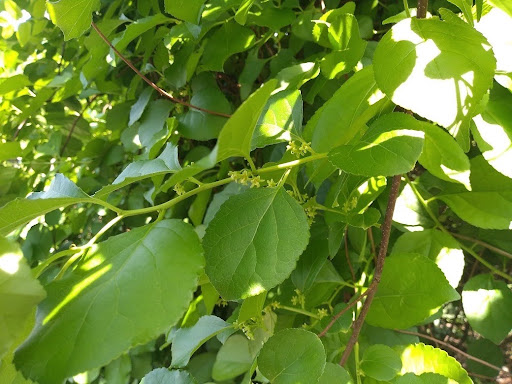
- Climbs high into tree canopies and girdles trunks
- Smothers understory shrubs and prevents tree regeneration
- Heavy vines can topple mature trees, especially during storms
- Bright fruits attract birds and people, spreading seeds widely
- Root suckers and tip‑rooting create dense, tangled thickets
How to Identify It
(See detailed photos of Fairfax examples on iNaturalist.)
- Woody, twining vine that can climb 60 feet
- Bark on mature vines is tan or gray with a raised netted pattern
- Leaves alternate, glossy green, 2–5 inches long, with fine blunt teeth
- Bright yellow fall color develops late
- Fruits begin green, ripen to golden‑yellow, then split to reveal red arils
- Roots are bright orange — a distinctive feature
How It Spreads
- Birds eat and disperse the bright red fruits
- People spread vines when using fruiting stems for decorations
- Seeds germinate readily, even in shade
- Root suckers and branch tips form new plants
- Cutting without herbicide leads to vigorous resprouting
For More Information
Please visit Blue Ridge PRISM for the full Asiatic Bittersweet Fact Sheet.